- Home
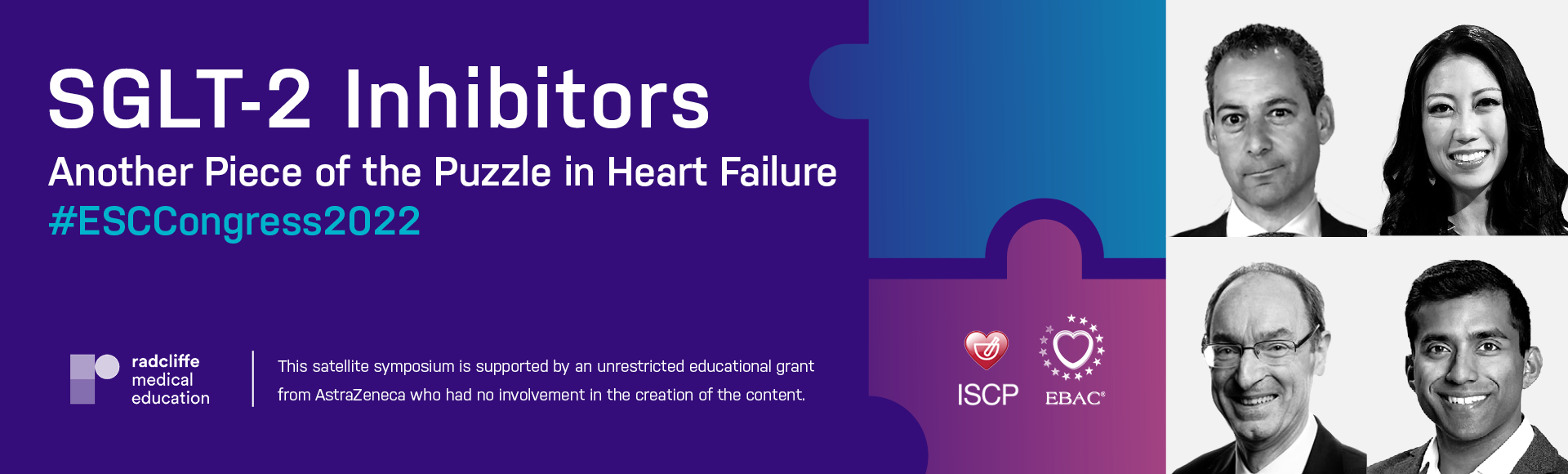
- SGLT-2 Inhibitors - Another Piece of the Puzzle in Heart Failure
SGLT-2 Inhibitors - Another Piece of the Puzzle in Heart Failure
- Heart Failure
Available Credit:
- 1.00
Course Published On:
Course Expiry Date:
Overview
Presented, and recorded, at the ESC in Barcelona, this unique broadcast, ‘SGLT-2 Inhibitors - Another Piece of the Puzzle in Heart Failure’, is centred around the presentation of the latest SGLT-2 inhibition data and how this translates to the treatment of Heart Failure patients.
Radcliffe Medical Education is delighted to introduce the globally renowned faculty. Chaired by Prof Scott Solomon (Boston, US), this session brings together a leading international faculty of Prof John McMurray (Glasgow, UK), Prof Carolyn Lam (Singapore, SG) and Dr Muthiah Vaduganathan (Boston, US) to assess the latest data for SGLT2 inhibitors in heart failure (HF) and how to apply it in real-world practice.
Support Statement
This satellite symposium is supported by an unrestricted educational grant from AstraZeneca who had no involvement in the creation of the content.
Disclosure
In compliance with EBAC guidelines, all speakers/chairpersons participating in this programme have disclosed or indicated potential conflicts of interest which might cause a bias in the presentations. The Organising Committee/Course Director is responsible for ensuring that all potential conflicts of interest relevant to the event are declared to the audience prior to the CME activities.
Terms & Conditions
Radcliffe Education requires contributors to our CME programmes to disclose any relevant financial relationships that have occurred within the past 12 months that could create a conflict of interest. These will be identified in the faculty section if applicable.
The session, ‘SGLT-2 Inhibitors - Another Piece of the Puzzle in Heart Failure’ is accredited by the European Board for Accreditation in Cardiology (EBAC) for 1 hour of external CME credits.
Each participant should claim only those hours of credit that have actually been spent in the educational activity. EBAC works according to the quality standards of the European Accreditation Council for Continuing Medical Education (EACCME), which is an institution of the European Union of Medical Specialists (UEMS).
Through an agreement between the European Board for Accreditation in Cardiology and the American Medical Association, physicians may convert EBAC External CME credits to AMA PRA Category 1 Credits™. Information on the process to convert EBAC credit to AMA credit can be found on the AMA website.
Instructions to Participants
There is no fee for taking part in this online learning activity.
Activities are designed to be completed within 60 minutes and must be completed by the registered user. Physicians should only claim credits for time spent on the activity. To successfully earn credit, participants must complete the activity in full in the indicated time frame.
To complete the course and claim certification participants must:
- Read the course outline information supplied and complete pre-test questions if supplied prior to starting the activity. Users must read and study the activity in its entirety before completing the post-test questions.
- Your results will be automatically saved and if a pass score is achieved (where applicable), you may be eligible to claim credit for the activity and receive a certificate of completion.
Target Audience
- Global Cardiologists
- Heart Failure Specialists
- Primary Care Physicians
- Nurses
- Pharmacists
Learning Objectives
Upon completion of this activity, participants will be able to:
- Recall the results of key trials in HFmrEF in different patients' sub-groups
- Describe how SGLT-2 inhibitors can be used across the range of LVEF
- Apply emerging diagnostic approaches for HFpEF and HFmrEF
- Implement best-practice strategies across the range of LVEF
SGLT2 Inhibitors in HFpEF: Light at the End of the Tunnel
Duration: 15 min
Speakers: Scott Solomon (Brigham and Women's Hospital / Harvard Medical School, Boston, US)
SGLT2 Inhibitors Across the Spectrum of Heart Failure
Duration: 10 min
Practical Considerations For Treating HF With Mildly Reduced and Preserved EF
Duration: 10 min
Speakers: Carolyn Lam (National Heart Centre Singapore Duke-NUS, Singapore, Singapore, SG)
Implementing Best Practices Across the Spectrum of Heart Failure
Duration: 10 min
Discussion
Duration: 15 min
Speakers: Scott Solomon (Brigham and Women's Hospital, Boston, US / Harvard Medical School, Boston, US) John JV McMurray (Institute of Cardiovascular and Medical Sciences, University of Glasgow, Glasgow, UK) Carolyn Lam (National Heart Centre Singapore Duke-NUS, Singapore, Singapore, SG) Muthiah Vaduganathan (Brigham and Women's Hospital Heart and Vascular Center and Harvard Medical School, Boston, Boston, US)




Related Courses

- Not accredited
Published:
Learning objectives
- Recall guideline recommendations for the use of NT-proBNP in heart failure
- Describe current practices in heart failure diagnosis and the impact on treatment outcomes
- Develop an optimised approach to the timely diagnosis and management of heart failure

- 2.00
Published:
Learning objectives
- Recall clinical evidence and guidelines for the management of CKD patients without diabetes
- Describe current gaps and barriers in evidence-based management for CKD without diabetes
- Apply evidence based-management strategies to a case study
- Use expert-led guidance to develop an optimal management approach to CKD patients without diabetes

- Not accredited
Published:
Learning objectives
- Appraise new updates in heart failure guideline-directed medical therapy (GDMT)
- Apply latest guideline recommendations to patient cases
- Describe barriers preventing early initiation of GDMT
- Identify the roles of nurses and other healthcare professionals to achieve optimal heart failure therapy
- Identify the importance of the nurse/cross-functional team

- 1.00
Published:
Learning objectives
- To differentiate ATTR phenotypes based on presenting signs and symptoms.
- To select appropriate tests to monitor symptomatic ATTR-cm from imaging, biomarker, functional and QoL assessments.
- To recall how to identify disease progression across ATTR-cm.
- To describe the different disease modifying treatments for ATTR including novel agents.

- Not accredited
Published:
Learning objectives
- Appraise the urgency needed in rapid initiation of GDMT to improve HF outcomes.
- Recognise barriers preventing the use of GDMT in current practice.
- Identify strategies needed to drive implementation of GDMT in clinical practice.

- Not accredited
Published:
Learning objectives
- Explain the relationship between sub-optimal RAASi therapy and poor cardio-renal outcomes
- Identify patients who would benefit from anti-hyperkalaemia medications
- Select appropriate anti-hyperkalaemia treatments across a range of patient profiles
- Adopt anti-hyperkalaemia medications as an approach to prolong optimal RAASi therapy
- Summarise current guideline recommendations on the use of potassium binding agents

- 1.00
Published:
Learning objectives
- Identify individuals likely to have HFpEF from initial presentation
- Refer suspected individuals for specialist assessment
- Initiate GDMT for HF as soon as patients are stable
- Initiate GDMT in HF regardless of EF and phenotype
- Initiate shared decision-making on complex HF patients with other members of the multidisciplinary team including cardiologists, GPs, nephrologists and diabetologists

- 1.00
Published:
Learning objectives
- Recall the general approach to diagnosis and stratification of HCM according to the latest guidelines and expert opinion
- Apply advanced echocardiographic methodologies to equivocal HCM diagnoses
- Select appropriate imaging modalities to facilitate accurate risk stratification
- Stratify patients based on specific risk features and disease severity
- Choose suitable treatment modalities for patients based on specific disease features and severity

- 1.00
Published:
Learning objectives
- Review current GDMT in HFrEF and HFpEF
- Describe the relationship between initiation of GDMT and HF outcomes
- Prescribe GDMT according to current international recommendations
- Recall the elements of the Kansas City Cardiomyopathy Questionnaire
- Describe the clinical studies that support the use of functional and QoL measures in practice
- Initiate quality of life and functional improvement measures in routine practice
- Initiate SGLT-2 inhibitors in patients presenting with De novo HF and in patients already on other GDMT
- Adopt shared decision-making with HF patients

- 1.00
Published:
Learning objectives
- Recall the utility of EF in heart failure treatment, patient selection and treatment response
- Identify alternative measures to EF for the purposes HF severity and therapeutic efficacy
- Incorporate quality of life measures for assessing therapeutic efficacy in HF
- Recall outcomes from heart failure trials from recent congress and publications and their impact on practice