- Home
- Intracoronary Imaging for PCI: A Practical Approach to OCT
Intracoronary Imaging for PCI: A Practical Approach to OCT
- Intervention
Available Credit:
- 1.00
Course Published On:
Course Expiry Date:
Overview
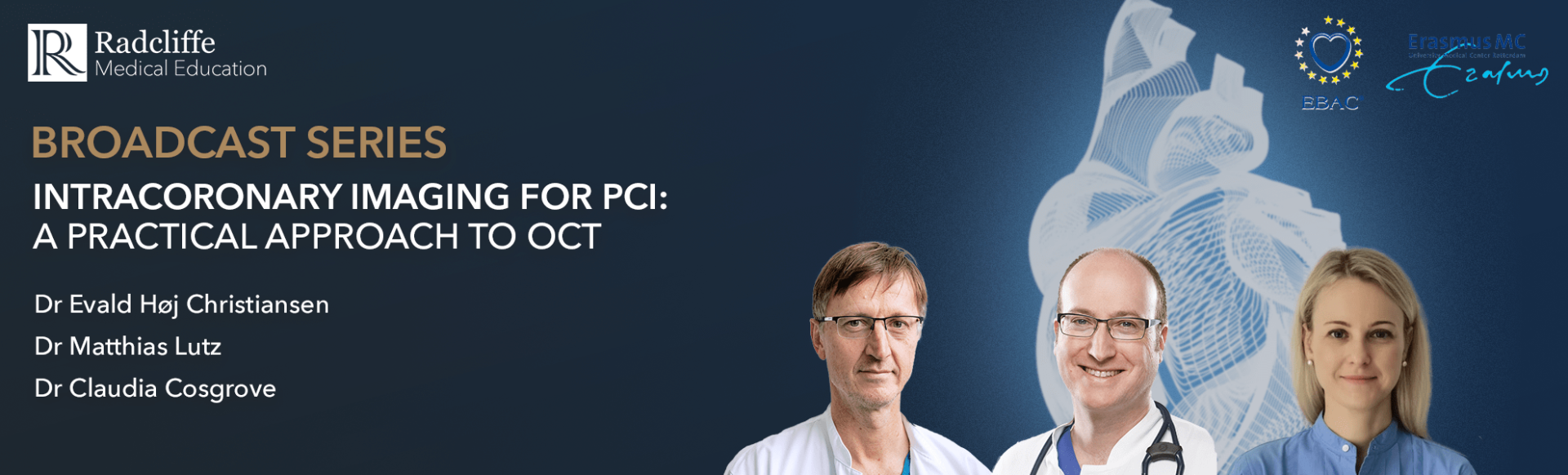
In this session, ‘Intracoronary imaging for PCI: A practical approach to OCT’ part of the ‘Optimising the Use of Contemporary Invasive Imaging for PCI’ series a leading faculty discuss the use of imaging and angiography for procedural planning and PCI optimisation. Through the use of cases, faculty will explore how imaging has been used to maximise successful stent implantation.
‘Optimising the Use of Contemporary Invasive Imaging for PCI aims to offer education on proper image acquisition, interpretation, and correct decision-making to optimise the use of contemporary imaging. The programme provides an overview of the current use of intravascular ultrasound (IVUS) and optical coherence tomography (OCT), the relative advantages of each technique and real-world insight from imaging experts.
Support Statement
This programme is supported by unrestricted educational grant by Abbott. The scientific programme has not been influenced in any way by the sponsors.
Disclosure
In compliance with EBAC / EACCME guidelines, all speakers/chairpersons participating in this programme have disclosed or indicated potential conflicts of interest which might cause a bias in the presentations.
The Organising Committee/Course Director is responsible for ensuring that all potential conflicts of interest relevant to the event are declared to the audience prior to the CME activities.
Terms & Conditions
Radcliffe Education requires contributors to our CME programmes to disclose any relevant financial relationships that have occurred within the past 12 months that could create a conflict of interest. These will be identified in the faculty section if applicable.
The session of ‘Intracoronary imaging for PCI: A practical approach to OCT' is accredited by the European Board for Accreditation in Cardiology (EBAC) for 1 hour of external CME credits.
Each participant should claim only those hours of credit that have actually been spent in the educational activity. EBAC works according to the quality standards of the European Accreditation Council for Continuing Medical Education (EACCME), which is an institution of the European Union of Medical Specialists (UEMS).
Through an agreement between the European Board for Accreditation in Cardiology and the American Medical Association, physicians may convert EBAC External CME credits to AMA PRA Category 1 Credits™. Information on the process to convert EBAC credit to AMA credit can be found on the AMA website.
Target Audience
- Cardiologists
- Interventionalists
- Physicians within the peripheral intervention space
- Imaging specialists
Learning Objectives
Upon completion of this activity, participants will be able to:
- Incorporate contemporary imaging for PCI in appropriate patients
- Differentiate between modern imaging techniques based on clinical data
- Recall best practices for image acquisition, interpretation and decision-making
- Interpret image data and make clinical decisions generated from existing case study data
Module |
Title |
Duration |
Speakers |
|---|---|---|---|
| Session 1 | Plenary Presentations | 25 minutes | Matthias Lutz (University Medical Center of Schleswig-Holstein) Claudia Cosgrove (St George’s Hospital) Evald Christiansen (Aarhus University Hospital) |
| Session 2 | Case Studies | 24 minutes | Matthias Lutz (University Medical Center of Schleswig-Holstein) Claudia Cosgrove (St George’s Hospital) Evald Christiansen (Aarhus University Hospital) |
| Session 3 | Faculty discussion | 20 minutes | Matthias Lutz (University Medical Center of Schleswig-Holstein) Claudia Cosgrove (St George’s Hospital) Evald Christiansen (Aarhus University Hospital) |
Plenary Presentations
Duration: 25 minutes
Speakers: Matthias Lutz (University Medical Center of Schleswig-Holstein) Claudia Cosgrove (St George’s Hospital) Evald Christiansen (Aarhus University Hospital)
Case Studies
Duration: 24 minutes
Speakers: Matthias Lutz (University Medical Center of Schleswig-Holstein) Claudia Cosgrove (St George’s Hospital) Evald Christiansen (Aarhus University Hospital)
Faculty discussion
Duration: 20 minutes
Speakers: Matthias Lutz (University Medical Center of Schleswig-Holstein) Claudia Cosgrove (St George’s Hospital) Evald Christiansen (Aarhus University Hospital)



Related Courses

- 1.00
Published:
Learning objectives
- Recall TAVI SMART trial data and the implications on clinical practice
- Describe novel valve designs and the impact on long-term performance
- Develop an expert-led approach to improving equitable access to TAVI
- 1.00
Published:
Learning objectives
- Evaluate the factors influencing coronary access in different valve designs
- Formulate strategies to optimise coronary access based on valve characteristics
- Evaluate the role of valve design in reducing pacemaker implantation rates and enhancing future coronary access
- Learn the step-by-step process for achieving optimum implant depth during TAVI
- Apply guidelines and best practices for achieving and confirming optimum implant depth in TAVI procedures

- 1.00
Published:
Learning objectives
- Recall current and predicted trends in TAVI with respect to preserving coronary access
- Consider determining factors for choosing valves in low risk populations
- Discuss solutions for maximising valve durability and haemodynamics and for treating degenerated TAVI
- 1.00
Published:
Learning objectives
- Compare the utility of repair and replacement valve technology in mitral regurgitation
- Individualise valve choice for aortic regurgitation based on valve durability and patient features
- Recall the utility and limitations of specialty balloons
- Evaluate emerging approaches to the treatment of complex left main and other coronary bifurcation lesions
- Discuss the impact of PCI on top of optimal medical therapy in ischaemic left ventricular systolic dysfunction
- Identify suitable patients for interatrial shunting
- Discuss the merits of alternative antiplatelet strategies to DAPT in ACS and CCS following PCI
- 1.00
Published:
Learning objectives
- Compare the utility of repair and replacement valve technology in mitral regurgitation
- Individualise valve choice for aortic regurgitation based on valve durability and patient features
- Recall the utility and limitations of specialty balloons
- Evaluate emerging approaches to the treatment of complex left main and other coronary bifurcation lesions
- Discuss the impact of PCI on top of optimal medical therapy in ischaemic left ventricular systolic dysfunction
- Identify suitable patients for interatrial shunting

- 1.00
Published:
Learning objectives
- Compare the utility of repair and replacement valve technology in mitral regurgitation
- Individualise valve choice for aortic regurgitation based on valve durability and patient features
- Recall the utility and limitations of specialty balloons
- Evaluate emerging approaches to the treatment of complex left main and other coronary bifurcation lesions
- Discuss the impact of PCI on top of optimal medical therapy in ischaemic left ventricular systolic dysfunction
- Identify suitable patients for interatrial shunting
- 1.00
Published:
Learning objectives
- Compare the utility of repair and replacement valve technology in mitral regurgitation
- Individualise valve choice for aortic regurgitation based on valve durability and patient features
- Recall the utility and limitations of specialty balloons
- Evaluate emerging approaches to the treatment of complex left main and other coronary bifurcation lesions
- Discuss the impact of PCI on top of optimal medical therapy in ischaemic left ventricular systolic dysfunction
- Identify suitable patients for interatrial shunting
- Discuss the merits of alternative antiplatelet strategies to DAPT in ACS and CCS following PCI
- 1.00
Published:
Learning objectives
- Compare the utility of repair and replacement valve technology in mitral regurgitation
- Individualise valve choice for aortic regurgitation based on valve durability and patient features
- Recall the utility and limitations of specialty balloons
- Evaluate emerging approaches to the treatment of complex left main and other coronary bifurcation lesions
- Discuss the impact of PCI on top of optimal medical therapy in ischaemic left ventricular systolic dysfunction
- Identify suitable patients for interatrial shunting
- Discuss the merits of alternative antiplatelet strategies to DAPT in ACS and CCS following PCI
- 1.00
Published:
Learning objectives
- Compare the utility of repair and replacement valve technology in mitral regurgitation
- Individualise valve choice for aortic regurgitation based on valve durability and patient features
- Recall the utility and limitations of specialty balloons
- Evaluate emerging approaches to the treatment of complex left main and other coronary bifurcation lesions
- Discuss the impact of PCI on top of optimal medical therapy in ischaemic left ventricular systolic dysfunction
- Identify suitable patients for interatrial shunting
- Discuss the merits of alternative antiplatelet strategies to DAPT in ACS and CCS following PCI
- 1.00
Published:
Learning objectives
- Compare the utility of repair and replacement valve technology in mitral regurgitation
- Individualise valve choice for aortic regurgitation based on valve durability and patient features
- Recall the utility and limitations of specialty balloons
- Evaluate emerging approaches to the treatment of complex left main and other coronary bifurcation lesions
- Discuss the impact of PCI on top of optimal medical therapy in ischaemic left ventricular systolic dysfunction
- Identify suitable patients for interatrial shunting
- Discuss the merits of alternative antiplatelet strategies to DAPT in ACS and CCS following PCI